



What is lead retrieval? How it works at trade shows
Lead retrieval explained: how exhibitors scan badges at trade shows, the devices and apps organizers rent, what it costs and how an app you own compares.
The short answer: lead retrieval is how exhibitors capture the details of people who visit their booth at a trade show or conference. Booth staff scan the visitor's badge with a device or an app, and the visitor's registration details become a lead. Most organizers sell lead retrieval to exhibitors as an add-on for each show.
This guide explains what lead retrieval means, how the technology works, what you get and what you pay, and how a lead capture app that you own compares with the one the organizer rents you.
Lead retrieval meaning
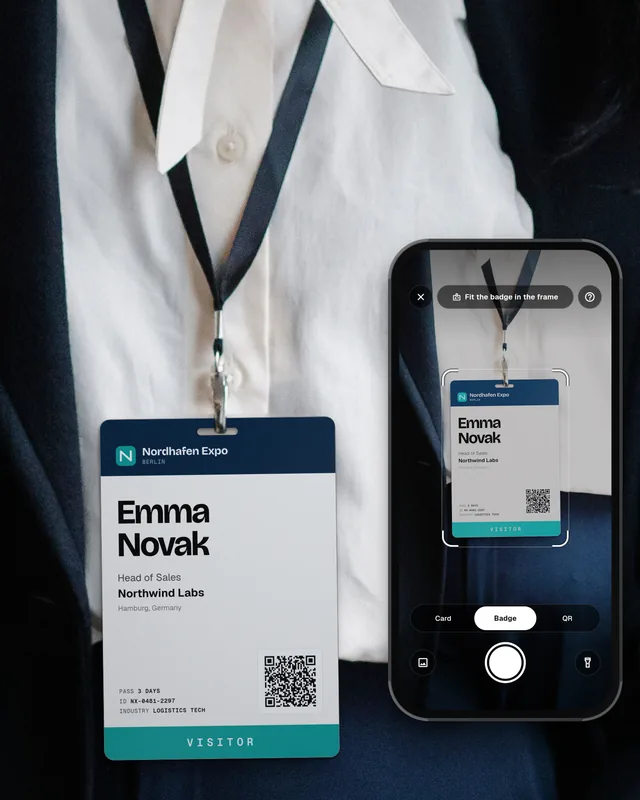
Lead retrieval is a method for capturing and processing sales leads at an event, trade show or conference (Wikipedia: Lead retrieval). Attendees give their details when they register. They then wear a badge with a barcode, a QR code or an ID number. When an exhibitor scans that code, the lead retrieval system looks up the person in the registration database and saves the record for the exhibitor.
So the badge itself often holds very little. The value sits in the organizer's registration data, and the lead retrieval tool is the key that unlocks it for one show.
How lead retrieval works, step by step
Step 1: The attendee registers
The organizer collects name, company, job title and the answers to its own registration questions.
Step 2: The attendee gets a badge
The badge carries a code that points to that registration record. Some badges also hold the contact details in the code itself.
Step 3: Booth staff scan the badge
With a rented handheld scanner or the organizer's lead retrieval app on a phone, often with a few qualifying questions and a note.
Step 4: The exhibitor gets the leads
During or after the show, the exhibitor downloads the scanned leads from the vendor's portal and imports them into the CRM.
Lead retrieval devices and apps
There are two common types of lead retrieval tools (Wikipedia):
- A lead retrieval device: a handheld badge scanner that the organizer or its vendor rents to exhibitors for the show.
- A lead retrieval app: an app the organizer provides, installed on the exhibitor's own phones, so there is no hardware to rent.
The codes on badges vary. Some hold a full digital business card that almost any scanning app can read. Others hold only an ID that the organizer's own system can resolve (ATIV Software). That is why many shows tell exhibitors to use the official tool.
What you get from lead retrieval
The organizer decides which fields you receive. You usually get contact details plus job title, company name and sometimes company size, but you cannot change the registration questions to fit your sales process (Wikipedia). Personal mobile numbers and direct dials are rarely part of it, because attendees did not register to give them to every booth.
What lead retrieval costs
Prices are published in exhibitor order forms. Two examples from the 2026 forms: at SEMA Show, one XPress Leads app activation was $455 through 22 September and $525 after, and a handheld rental was $605 and then $685 (SEMA order form). At the National Restaurant Association Show, a mobile app package for 3 users was $579 before 2 April and $599 after, with extra users at $149 each (order form).
Most of these licenses work at one event only, so the cost comes back at every show. Our guide Lead retrieval cost compares more order forms and the costs that are not on the form.
Lead retrieval vs a lead capture app you own
Where it works
- Organizer lead retrieval
- One show
- Your own lead capture app
- Every show, meeting and side event
What it reads
- Organizer lead retrieval
- That show's badges, including coded ones
- Your own lead capture app
- Badges with readable details, printed names, business cards and QR codes
Data you get
- Organizer lead retrieval
- The fields the organizer collected
- Your own lead capture app
- What you scan, plus anything the app adds, such as email and company data
Getting leads into the CRM
- Organizer lead retrieval
- Download and import after the show
- Your own lead capture app
- Depends on the app. Some sync each lead as you scan
Cost
- Organizer lead retrieval
- Paid again for each show
- Your own lead capture app
- A subscription or license you keep
| Organizer lead retrieval | Your own lead capture app | |
|---|---|---|
| Where it works | One show | Every show, meeting and side event |
| What it reads | That show's badges, including coded ones | Badges with readable details, printed names, business cards and QR codes |
| Data you get | The fields the organizer collected | What you scan, plus anything the app adds, such as email and company data |
| Getting leads into the CRM | Download and import after the show | Depends on the app. Some sync each lead as you scan |
| Cost | Paid again for each show | A subscription or license you keep |
Many teams use both: the official tool at shows where the badge code is locked, and their own app for business cards, dinners, side meetings and events with no lead retrieval at all.
Where Swopi fits
Swopi is a lead retrieval app you own. Your team scans badges, business cards and LinkedIn QR codes with the Swopi app on their own iPhones and Android phones. When the badge QR code is locked, Swopi reads the name and company printed on the badge. Swopi AI then adds the missing work email, phone and company data, drafts the follow-up email, and sends the lead to HubSpot, Salesforce, Microsoft Dynamics 365, Zoho CRM, Pipedrive or monday.com with the event name attached.
What does lead retrieval mean at a trade show?
It means capturing booth visitors as leads by scanning their badges. The scan pulls the visitor's registration details from the organizer's system into your lead list.
What is a lead retrieval device?
A handheld badge scanner that the organizer or its vendor rents to exhibitors for one show. Many shows now also offer an app for your own phone instead.
Do I have to buy the organizer's lead retrieval?
No, unless the show requires it. It is the only way to read badges that carry just an ID. An app like Swopi reads the printed name and company instead, and works at every event.
Can I get lead retrieval data into my CRM?
Yes. With the organizer's tool you usually download the leads and import them. With Swopi, each lead goes to your CRM as you scan it, with the event name.
Is lead retrieval the same as lead capture?
Lead retrieval usually means the organizer's badge scanning service. Lead capture is the wider term for any way you collect contacts at an event, including business cards, QR codes, forms and badge scanning.